

Japan’s Ministry of Finance trade data for June highlighted the structural pressures facing the yen. Exports increased by 19.3% year-on-year to JPY 10.929 trillion, exceeding market expectations. Growth was supported by the weaker yen, which improved the price competitiveness of Japanese companies abroad, as well as sustained demand for products linked to the global artificial intelligence investment cycle, including semiconductors and equipment used in data centres.
Imports rose even faster, increasing by 25.4% to a record JPY 11.336 trillion, compared with analysts’ forecast of approximately 21.0%. The increase reflected higher commodity costs, disruption to international logistics and continued volatility in the oil market. As a result, Japan recorded a trade deficit of JPY 406.9 billion, significantly wider than the projected shortfall of around JPY 120.0 billion.
Although crude oil import volumes declined by 13.7% from a year earlier, the value of those purchases surged by 59.3% as the yen-denominated cost of imported oil reached a record high. Japan’s cumulative trade deficit for the first half of 2026 amounted to approximately JPY 1.01 trillion. These figures underline the country’s exposure to imported inflation, although the yen’s weakness is also being driven by the interest rate gap with other major economies and concerns surrounding Japan’s fiscal and monetary policy outlook.
Market attention has also focused on Japan’s national inflation data. The core Consumer Price Index, which excludes volatile fresh food prices but includes energy, rose by 1.6% year-on-year in June, accelerating from 1.4% in May and matching market expectations. The increase was partly linked to a base effect created by government gasoline subsidies in the previous year.
The index excluding both fresh food and fuel, which the Bank of Japan monitors as a measure of underlying inflation, increased by 1.7% year-on-year, slowing from 1.8% in May. Food inflation moderated as rice prices declined, while services inflation eased to 1.2% from 1.4%. Nevertheless, the weak yen, higher producer prices and elevated energy costs could push consumer inflation higher again later in the year.
At its June meeting, the Bank of Japan raised its policy rate by 25 basis points to approximately 1.00%, the highest level in 31 years. The move formed part of the gradual normalisation of monetary policy following decades of exceptionally loose financial conditions. Further decisions will depend on domestic demand, wage growth and the economy’s ability to sustain inflation near the central bank’s 2.0% target.
The Bank of Japan’s next monetary policy meeting is scheduled for 30–31 July. The regulator is widely expected to leave the policy rate unchanged while publishing updated economic growth and inflation projections. However, the continued weakness of the yen remains an important risk because higher import costs could intensify inflationary pressure and increase the likelihood of another rate increase later in 2026.
Meanwhile, expectations surrounding US monetary policy continue to support the dollar. The Federal Reserve’s current target range stands at 3.50%–3.75%. According to the latest CME FedWatch pricing, markets assign approximately a 64.2% probability to the rate remaining unchanged at the 28–29 July meeting and a 35.8% probability to a 25-basis-point increase.
By the September meeting, the probability of rates remaining at their current level falls to around 19.9%. Markets assign a 55.4% probability to a cumulative increase of 25 basis points and a 24.7% probability to a cumulative increase of 50 basis points. These expectations have strengthened alongside higher oil prices and US Treasury yields.
The wide interest rate differential between the United States and Japan remains an important source of support for USD/JPY. The yen is also vulnerable to Japan’s dependence on imported energy, while the dollar continues to benefit from safe-haven demand and higher returns available on US assets. At the same time, the pair is approaching levels at which the risk of verbal or direct intervention by Japanese authorities could increase.
Support and Resistance Levels
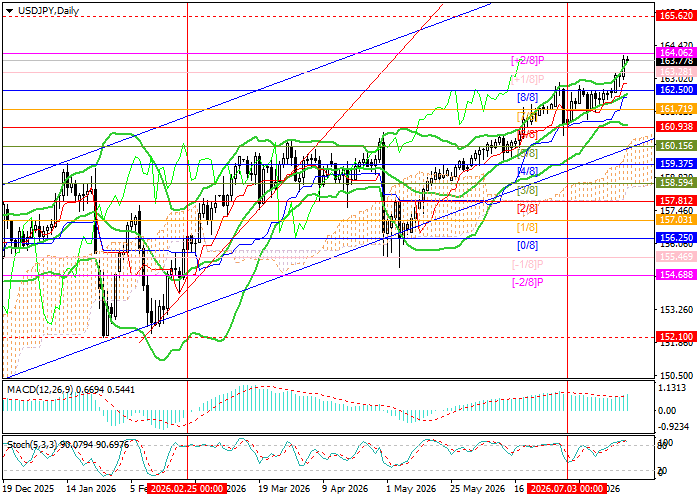
USD/JPY remains within a long-term ascending channel. The pair has approached 164.06, corresponding to the Murrey level [+2/8]. A confirmed breakout above this level could support further growth towards 165.62, corresponding to the weekly Murrey level [+1/8], and 168.75, corresponding to the weekly Murrey level [+2/8].
The key level for sellers remains 162.50, corresponding to the Murrey level [8/8] and reinforced by the middle line of the Bollinger Bands. A sustained decline below this level could extend the correction towards 160.93, corresponding to the Murrey level [6/8], and 159.37, corresponding to the Murrey level [4/8] and the lower boundary of the ascending channel.
Technical indicators continue to allow for further gains. The Bollinger Bands are directed upward, while the MACD histogram remains stable in positive territory. The Stochastic Oscillator has reached the overbought zone and may reverse lower in the near term, suggesting a possible correction, although its potential currently appears limited.
Resistance levels: 164.06, 165.62, 168.75.
Support levels: 162.50, 160.93, 159.37.
USD/JPY Trading Scenarios and Exchange Rate Forecast
The bullish scenario may become relevant after the price consolidates above 164.06, with targets at 165.62 and 168.75. The protective stop-loss level is set at 162.90. Estimated timeframe: five to seven days. The bearish scenario may become relevant after the price consolidates below 162.50, with targets at 160.93 and 159.37. The protective stop-loss level is set at 163.10.
Bullish Scenario
| Timeframe | Weekly |
| Order Type | BUY STOP |
| Entry Point | 164.06 |
| Take Profit | 165.62, 168.75 |
| Stop Loss | 162.90 |
| Key Levels | 159.37, 160.93, 162.50, 164.06, 165.62, 168.75 |
Alternative Scenario
| Order Type | SELL STOP |
| Entry Point | 162.50 |
| Take Profit | 160.93, 159.37 |
| Stop Loss | 163.10 |
| Key Levels | 159.37, 160.93, 162.50, 164.06, 165.62, 168.75 |